


Infant Feeding is support in the early days by your midwife and following this by your Health Visitor.
Please contact your midwife or health visitor if you need any advice with feeding your baby. If specialised support is needed a referral can be made to our Infant Feeding Leads.
-
Antenatal Classes and Information
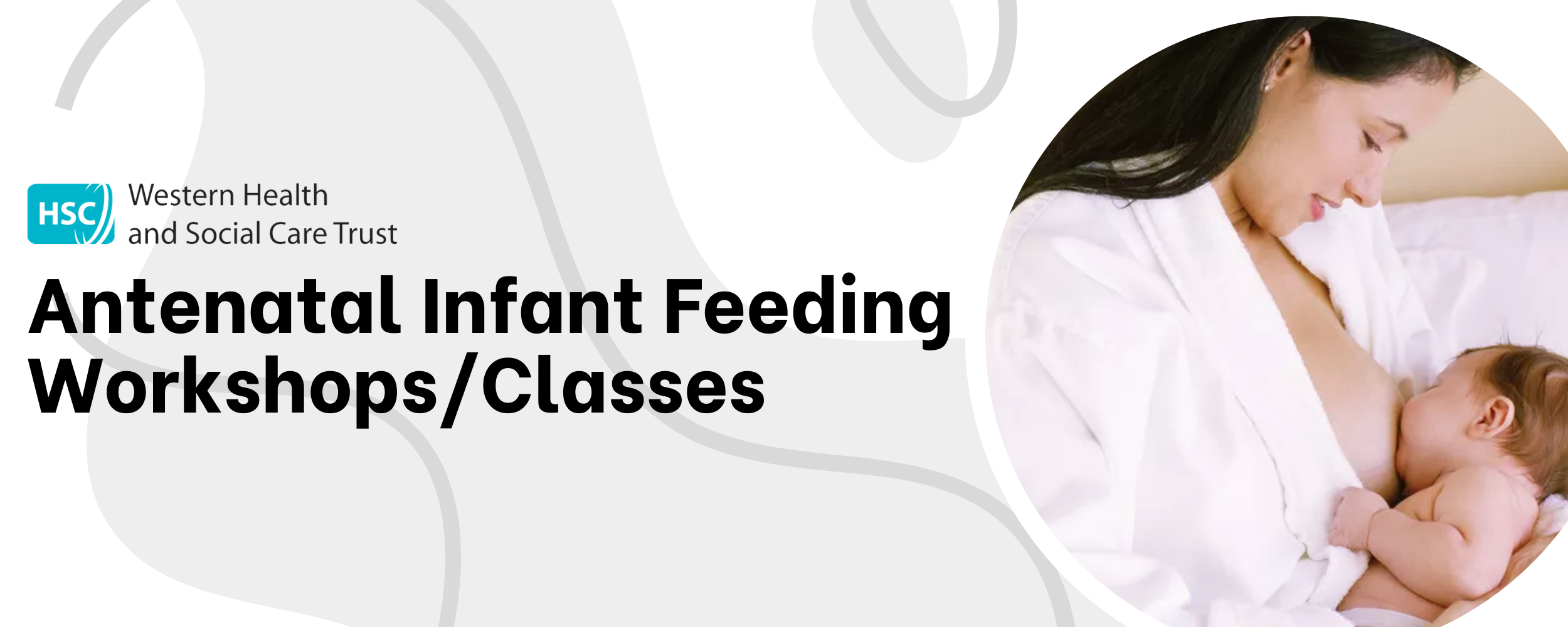
We offer both in person and online and face to face antenatal breastfeeding classes, details of both are outline below. Our classes are led by our Infant Feeding Team and Western Trust Lactation Consultant (IBCLC) is present. You are welcome to attend with a partner or supportive friend/relative.
These workshops will provide you with the information and resources needed to get your infant off to a good start including:-
- Benefits of breastfeeding for your baby, you and the environment
- How to develop a relationship with your unborn baby
- Colostrum Harvesting
- How to hold and attach your baby at the breast
- What to expect in the first few weeks
- How do you know your baby is getting enough milk
- Support available
Face-to-face Antenatal Breastfeeding Classes
These take place in Derry Well Women Queen Street and Minding Mum, WNP office Shared Future Centre Waterside, Altnagelvin Hospital. Omagh Hospital and Primary Care Complex and South West Acute Hospital, Enniskillen.
Antenatal women, their partners and/or interested family members are all welcome.
Derry/Londonderry
Minding Mum Waterside ‘Latch and learn’- for details of dates and to book your place, please message 07719532034
Derry Well Woman – Queen Street Derry- for details of dates and to book your place please telephone 028 7136 0777
Upcoming Events
15th October | 2-4PM | MDEC, Altnagelvin
12th November | 7-9PM | Board Room, Omagh Hospital and Primary Care Complex
Thursday 26th November | 2-4pm | MDEC Building Altnagelvin Hospital
Wednesday 2nd December | 6:30-8:30pm | Burnfoot Hub 292 Drumrane Road Dungiven BT47 4NL
Thursday 10th December | 7-9PM | Lecture Theatre, South West Acute Hospital
Thursday 10th December | 7-9pm | Lecture Theatre, South West Acute Hospital
Thursday 14th January 2027 | 2-4pm |MDEC Building Altnagelvin Hospital
Thursday 28th January | 7-9pm | Omagh Hospital and Primary Care Complex, Board Room
Thursday 11th February | 7-9pm | Lecture Theatre, South West Acute Hospital
Wednesday 3rd March | 6:30-8:30pm | Burnfoot Hub 292 Drumrane Road Dungiven BT47 4NL
Click here to book via our online form. If you require more information, please contact your midwife or health visitor.
Online Antenatal Breastfeeding Class
Our online breastfeeding class takes place on the first Friday of every third month; September, December, March and June from 10.30am-12.00pm.
Click here to book via our online booking form
For details of any other antenatal classes in your area please discuss with your midwife.
Parent Craft Classes
Parent Craft Programme – for all Western Trust Maternity Users
- South West Acute Hospital | First and Second Tuesday of every month | 2.00pm – 4.00pm
- Omagh Hospital and Primary Care Complex | First and Second Thursday of every month | 2.00pm – 4.00pm
Early booking recommended. To book a place, contact your community midwife or use the online form
Birthing partners also welcome.
Free online Antenatal Breastfeeding Workshop
Online Antenatal Course (Access Code: NIBABIES)
The NHS offers a free course on understanding pregnancy, labour, birth and your baby. A course also available for women couples. Courses are available in different languages.
The course is designed by clinical psychologists, midwives, health professionals and other parents, the comprehensive online antenatal course modules cover everything from preparing for birth to building a relationship with your baby that sets them up to thrive. By following one of our courses, you will learn everything you need to know about becoming a parent, including:
- Your emotional wellbeing
- Getting to know your baby in the womb
- Your baby’s development
- Relaxing and breathing techniques
- Your body and preparing for labour
- Stages of labour and types of delivery
- Pain relief
- Your feelings during labour
- Feeding your baby
- Comforting your baby
Preparing for baby information
Skin to Skin
Following delivery, where possible baby will be put skin to skin. This helps to:
- calm and relaxes both mother and baby
- regulate the baby’s heart rate and breathing, helping them to better adapt to life outside the womb
- regulate temperature
- enables colonisation of the baby’s skin with the mother’s friendly bacteria, which then helps in providing protection against infection
- stimulate the release of hormones to support breastfeeding and mothering
Skin to skin can be used as a parenting tool, anytime after baby’s delivery. To help calm baby, promote bonding and/or to help with breastmilk supply.
Building a relationship with your baby
Building a strong relationship between parents/care giver and their new baby will give them the best possible start in life and will help them to grow up happier and confident, developing a secure attachment. This strong relationship, starting in pregnancy and continuing into the early days, weeks and months of a baby’s life.
UNICEF provide a leaflet on how to help promote this relationship and brain development: This is good not only for baby but for parents and helps to release a hormone called oxytocin, which is also known as the ‘love hormone’
Building a Happy Baby – Unicef
The NHS Solihull approach video and the UNICEF ‘Importance of Relationship Building’ video look at baby brain development and the importance of social interactions and responsive parenting.
The Importance of Relationship Building Video – Baby Friendly Initiative – Unicef
-
Breastfeeding Your Baby
What’s in Breastmilk?
Benefits of Breastfeeding
The benefits of breastfeeding – Baby Friendly Initiative – Unicef
Breastfeeding and Relationship Building
Building a Happy Baby – Unicef
The Importance of Relationship Building Video – Baby Friendly Initiative – Unicef
Preparation for Baby
Getting off to a Good Start
Visit the HSC Public Health Agency website for more information
The PHA publication ‘Off to a good start’ presents the reasons why mothers and babies benefit from breastfeeding and explains how to breastfeed successfully.
It covers issues including how breastfeeding works, positioning and attachment, how to know if breastfeeding is going well, expressing milk, breastfeeding and babies in special care, advice on breastfeeding and bed-sharing, dealing with common problems, fitting breastfeeding into your life, and going back to work
ABM – How Lactation Works Video
Colostrum Harvesting
How to Harvest your colostrum – Video
Read the Colostrum Information Leaflet
If you wish to avail of support via text or telephone from breastfeeding mothers within your local area. Contact your Midwife, Health Visitor or the Peer Support Link Worker at
Teresa.McPhilemy@westerntrust.hscni.net
077 9504 3205Tongue-Tie
Suspected Tongue Tie Assessment Referral Leaflet
Specialised Breastfeeding Support
Women can access the Infant Feeding leads within the Trust for specialist breastfeeding if required. Speak to your midwife or health visitor regarding this.
Peer Support Mothers
We have a peer volunteer service to support Breastfeeding women. This is a group of local women who have breast fed their own babies. They have attended volunteer and Breastfeeding training within the Trust. They can provide telephone and text support to new mothers and they attend the local breastfeeding support groups. Prior to discharge from hospital, you will be asked if you wish to avail of this service.
If you wish to avail of support via text or telephone from breastfeeding mothers within your local area. Contact your Midwife, Health Visitor or the Peer Support Link Worker:-
Altnagelvin Hospital –Teresa.McPhilemy@westerntrust.hscni.net 077 9504 3205
South West Acute Hospital: Clare.Graham@westerntrust.hscni.net
Sure Start
Sure starts and other community organisations provide Breastfeeding Support. Ask your midwife/health visitor for more information or contact your local Sure Start.
Dads and Grandparents
NHS – What dads should know about breast feeding?
Grandparents supporting breastfeeding
ABM – Congratulations you’re going to be a grandparent
ABM – Partners and Breastfeeding
Position and Attachment
Breastfeeding Attachment – Video – Global Health Media Project
How do I know my baby is getting enough?
Is Your Baby Getting Enough Milk – Video – Global Health Media Project
How to maximise milk production
Hand expressing
Hand expression video – Baby Friendly Initiative (unicef.org.uk)
Positions for Breastfeeding
Positions for Breastfeeding – Video – Global Health Media Project
Natural Breastfeeding – Love to Love Breastfeeding
Breastfeeding while sitting
Breastfeeding while lying
Amy- Rose and Ruby; A mothers experience breastfeeding in Pavlik Harness
Breastfeeding positions in Pavlik Harness
Breastfeeding support
(See also before delivery)
Breastfeeding and Returning to Work
The Western Trust are fully committed to supporting all Breastfeeding mothers in returning to work by providing free ‘Return to work packs’. For breastfeeding mothers wishing to avail of this complete the online form here
This pack will contain a cool bag, ice blocks, a reusable water bottle and breastmilk storage bottle to assist staff in continuing their breastfeeding journey. The pack will also contain additional information on safe storage of breastmilk.
NI Direct – Breastfeeding and going back to work
Unicef – Breastfeeding after returning to work or study
Working and Breastfeeding – La Leche League GB
Expressing and Storing Breastmilk – The Breastfeeding Network
Specialised Breastfeeding Support
Women can access the Infant Feeding Leads within the Trust for specialist breastfeeding support. A referral can be made via your midwife or health visitor.
Western Trust Milk Bank
The Western Trust has the only milk bank in Ireland. More information.
Tandem Feeding
Tandem Nursing – La Leche League GB
Breastfeeding During Pregnancy and Tandem Nursing – La Leche League International
Feeding Older Babies
Breastfeeding and teething – La Leche League GB
Breastfeeding Your Toddler: What to expect • KellyMom.com
Thinking of Weaning? – La Leche League GB
Feeding more than one baby
-
Breastfeeding Support Groups
Visit the BreastfedBabies.org website to search for Breastfeeding Support Groups in your local area.
Breastfeeding Support Group – Western Trust Southern Sector
Group Venue Time Contact Breastfeeding Support Group - Belleek Rainbow Surestart Mobile, Erne Gaels, 9 Common Road, BT93 3AR 3rd Thursday of every month at 10.30am - 12.00pm Breast Friends Omagh LAST SureStart - Gortin Road, Omagh Every Tuesday at 10.30am -12.00pm Health Visiting Secretary - 028 8283 5590 Breast Friends Enniskillen Fermanagh House - Broadmeadow Place, Enniskillen, Fermanagh Every Thursday at 10.30am -12.00pm Health Visiting Secretary - 028 6638 2109 Breastfeeding Support Group - Castlederg Rainbow Surestart, Castlderg (open to non-surestart) - 16 Hospital Road, Castlederg 2nd & 4th Monday of every month at 11.00am - 12.30pm Castlederg SureStart - 028 8167 9483 Milky Mamas Irvinestown Breastfeeding Group The Arc Centre - 116-122 Sally's Wood, Irvinestown, BT94 1HQ Every Monday at
10.30am -12.00pmAdele Paton - 075 2351 2714 Newtonbutler Breastfeeding Group SureStart - The Old Courthouse, Bridge Street, Newtonbutler, BT92 8EN Every Tuesday at 10.30am - 12.00pm Adele Paton - 075 2351 2714 Breast Feeding Support Group - Loughmacrory Fr. Mallon Park (new football complex) 2nd Wednesday of every month at 10:30am - 12:00pm Breastfeeding Support Group – Western Trust Northern Sector
Group Venue Times Contact Breastfeeding Support Feeding Edenballymore Sure Start - Old Library Trust, Healthy Living Centre, Creggan - Family Room Gasyard Monday 11:30AM - 12:30PM Catherine Millar - 028 7137 1670 Breastfeeding Support Feeding Shantallow Sure Start - Carnhill Resource Centre Tuesday 10:00AM - 11:30AM Michelle - mmcbrearty@surestartshantallow.org.uk
028 71356110Breastfeeding Support Group Waterside Surestart - Action for Children, Ebrington Tuesday 10:00AM -11:30AM Ashley.McLaughlin@actionforchildren.org.uk
028 7134 2286Breastfeeding Support Group Dungiven - Nora and Katie, 150 Main Street, Dungiven, BT47 4LG Tuesday 10:30AM - 12:30PM brona.mcsorley@westerntrust.hscni.net
07901511975Breastfeeding Support Group Old Roe Valley Hospital Building, 24d Benevenagh Drive Limavady BT47 0AQ
Wednesday 10:00AM - 11:30AM Caroline.okane@dryarch.co.uk
02877742904 / 02877729826Breastfeeding Support Group Strabane - Melvin Sports Complex, 1A Melvin Road, Strabane, BT82 9PP Wednesday 10:30AM - 12:00PM brona.mcsorley@westerntrust.hscni.net
07901511975Breastfeeding Support Group Derry Well Woman - 17 Queen Street Thursday 10:00AM - 12:00PM patricia@derrywellwoman.org
028 7136 0777Breastfeeding Support Group Little Hands Sure Start - Ringfort Road Hazelbanj Friday 10:30AM - 11:30AM Nicolle- nicolle.mckeever@westerntrust.hscni.net
028 7126 7524Breastfeeding Support Group Foyle Arena, 2 Limavady Road Derry/L'Derry BT47 6JY Monday 10:30 - 12:00PM *Starting 6th July* brona.mcsorley@westerntrust.hscni.net
07901511975 -
Bottle, combination and formula Feeding
Some parents may combination feed (breastfeed and use formula) or solely formula feed. For babies that are bottle fed it is important that parents have information on:
- Responsive bottle feeding
- Safe storage of breastmilk
- Suitable infant formulas
- How to safely prepare formula
Responsive and paced bottle feeding
If your baby is being fed either breastmilk or infant formula via a bottle, feeding as responsively as possible can help support the development of a close and loving parent-infant relationship. Pace feeding can help pace a feed and for breastfed babies slow the flow of milk and reduce risk of developing bottle preference. Babies are less likely to be overfed and it may help reduce reflux symptoms. Where possible the parent/care giver should bottle feed their baby to help develop that close relationship. It is recommended to limit, where possible, the number of people who bottle feed your baby to 2-3.
UNICEF’s Responsive bottle feeding leaflet, provides concise information on how to responsively and pace feed your baby.:-
Choosing a formula
Formula companies are strictly regulated and have standards for content. This is regulated by the International Code of marketing breastmilk substitutes.
In summary, if you are formula feeding your baby, first milk formula (no specific formula brand is recommended) is used until your baby is one years of age (unless a medical prescribed formula is required).
Follow on milks i.e. infant milks with a number 2 or 3 on the packaging are not normally required.
Visit the First Steps Nutrition website for evidence based information on infant formula
When to stop formula and bottles?
At one year’s of age babies can go on to whole cow’s milk* and it is advised they transition to a cup to drink from at this age.
*Please note if your baby has an allergy to cow’s milk or has a specific prescribed formula, seek advice from your health care professional, health visitor or dietician.
Safe Preparation of Formula
The PHA booklet on bottle feeding provides new safety information on the preparation and storage of infant formula milk and is aimed at minimising the risk of infection from bacteria that may sometimes be present in the milk powder. It explains how to sterilise feeding equipment and make up formula milk, and highlights the safety precautions that need to be observed. Public Health Agency: Bottlefeeding
NHS advice for making up powdered infant formula emphasises the need to use water that has been boiled in a kettle, and cooled to no less than 70 degrees C to kill any potential bacteria present. These infographics clearly demonstrate this.
Formula Preparation Machines
Safe preparation of formula is recommended as per the leaflet above and NHS guidelines. If a formula preparation machine is used the infographic provides suggestions.
Further information can be found at First Steps Nutrition website.
-
Western Trust Infant Feeding Rooms
Breastfeeding is welcome anywhere across the Western Trust.
If you would prefer a private, comfortable space to breastfeed your baby or express breast milk, dedicated Infant Feeding Rooms are available across our hospital sites.
Locations
- Altnagelvin Hospital: One infant feeding room, located past main reception and right.
- Omagh Hospital and Primary Care Complex: Three infant feeding rooms: one near Reception and two on the First Floor.
- South West Acute Hospital (SWAH): One infant feeding room, ground floor past main reception and left.
Our Infant Feeding Rooms
Our Infant Feeding Rooms provide a clean, quiet and welcoming environment for parents who would like additional privacy while feeding their baby or expressing breast milk.
Facilities typically include:
- Comfortable seating
- Baby changing facilities
- Hand washing facilities
- Information on infant feeding support
- A calm, private space for feeding or expressing
Supporting you
We are committed to supporting every family and helping you feed your baby in the way that is right for you.
Breastfeeding is welcome throughout all WHSCT facilities. Our infant feeding rooms are simply an additional option for parents who would prefer a private space.
- Additional Information
- Human Milk Bank
-
Useful Links including resources in other languages
Useful Links
UNICEF – Breastfeeding resources – Baby Friendly Initiative
Association of Breastfeeding Mothers advice on support new breastfeeding mothers during COVID19
Email: drugsinformation@breastfeedingnetwork.org.uk
Breastfeeding Support Helplines
- National Breastfeeding Helpline 0300 100 0212 open 24 hours
- National Breastfeeding Helpline in Welsh and Polish 0300 100 0212, press 1 for Welsh and 2 for Polish.
- National Breastfeeding Helpline in Bengali and Sylheti 0300 456 2421,
- NCT’s Infant feeding line 0300 330 0700 is open every day, 8am to midnight.
- La Leche League call back service 0345 120 2918, 8am to 11pm.
Breastfeeding support in other Health and Social Care Trusts
Information for those living within the Belfast Trust area
Information for those living within the Southern Trust area
Information for those living within the Northern Trust area
Information for those living within the Southern Eastern Trust area
Resources in different languages
Foreign language resources – breastfeeding – Baby Friendly Initiative
Professionals resources | The Lullaby Trust
Video Archive – Global Health Media Project
Support in languages other than English – La Leche League GB
Breastfeeding Information – A to Z – La Leche League International