


09/10/2026
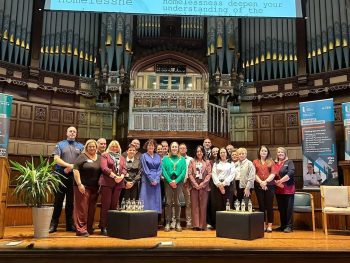
The Western Trust supported the Ulster University (UU) Health Inclusion Interprofessional Education (IPE) Conference at the Guildhall, Derry/Londonderry earlier this month.
More than 300 healthcare students from Ulster University attend the conference to explore how future healthcare professionals can play a vital role in addressing homelessness and reducing health inequalities.
Held during the week of World Homeless Day (10 October), the conference aimed to highlight homelessness as a significant public health issue and encourage greater awareness across all areas of healthcare. Organisers emphasised that addressing homelessness requires more than responding to immediate clinical needs. It requires an understanding of the wider social, environmental and structural factors that impact health and wellbeing, including housing insecurity, poverty, stigma, trauma, social exclusion and access to services.
The second Inclusion Health Interprofessional Education Conference brought together students from medicine, physiotherapy, occupational therapy, podiatry and dietetics to examine the complex relationship between homelessness and health and to develop collaborative approaches to delivering more equitable, person-centred care.
Led by Dr Caomhan Logue, Lecturer in Dietetics, and supported by a multidisciplinary team from Ulster University and Western Trust Inclusion Health service, the event placed lived experience at the centre of learning, offering students the opportunity to hear directly from people who have experienced homelessness, alongside professionals working on the frontline of homelessness and inclusion health services.
Michelle Doyle, Inclusion Homeless Health Nurse at the Western Trust said:
“As we mark World Homeless Day, it is important to recognise that homelessness is not only a housing issue but a health issue. People experiencing homelessness often face complex barriers that impact every aspect of their wellbeing. As healthcare professionals, we must look beyond immediate clinical needs and understand the wider circumstances affecting a person’s health. By doing so, we can provide more compassionate, person-centred care and work towards reducing health inequalities.”
The conference forms part of ongoing work to embed Inclusion Health principles within healthcare education, ensuring future practitioners are better equipped to support people facing social exclusion and health disadvantage. Learning outcomes were co-designed with individuals who have lived experience of homelessness and professionals working across homelessness, housing, health and addiction services.
Real Voices, Real Issues
The programme featured presentations from healthcare professionals, community organisations and individuals with lived experience of homelessness, providing students with valuable insight into the realities faced by people experiencing homelessness and the barriers they encounter when accessing healthcare and support services.
Guest speakers and contributors included representatives from:
- Methodist Mission Ashmore House
- Simon Community
- The DIME Project
- Western Health and Social Care Trust
- ARC (Addiction Recovery Coaching Service)
- Individuals with lived experience of homelessness
- Welcome Organisation – Mobile Health Unit
- Community and inclusion health practitioners from across the North West.
Special recognition is extended to Erin Bowen, Ann Barr, Trevor Holmes, Sandra Duffy, Jamie Wallace, and Gary Rutherford, whose expertise, lived experience, advocacy and commitment to inclusion health significantly enriched the learning experience for students.
Each session was supported by student-led discussion and reflective learning, encouraging participants to consider how healthcare services can become more inclusive, accessible and responsive to the needs of vulnerable and marginalised populations. A mobile health unit stationed in Guildhall Square also provided students with first-hand insight into outreach healthcare services.
Partnership Working
The event was delivered through strong partnership working between Ulster University, the Western Trust, and a range of statutory, voluntary and community organisations committed to improving outcomes for people experiencing homelessness.
The organising team would like to thank and acknowledge the support of:
- Mayor of Derry City and Strabane
- Guildhall and all their exceptional staff
- Derry City and Strabane Council
- Ulster University
- Methodist Mission Ashmore House
- Simon Community
- The DIME Project
- ARC Addiction Recovery Coaching Service
- Northern Ireland Housing Executive
- City Centre Initiative
- De Paul Floating Support Services
- WHSCT Inclusion Homeless Service
- WHSCT Alcohol and Drugs Service
- Mental health and recovery art exhibition.
Organisers hope the conference will continue to inspire future healthcare professionals to champion inclusion health, challenge stigma and recognise the importance of treating the whole person, not simply their presenting condition, in order to reduce health inequalities and improve outcomes for people experiencing homelessness.